

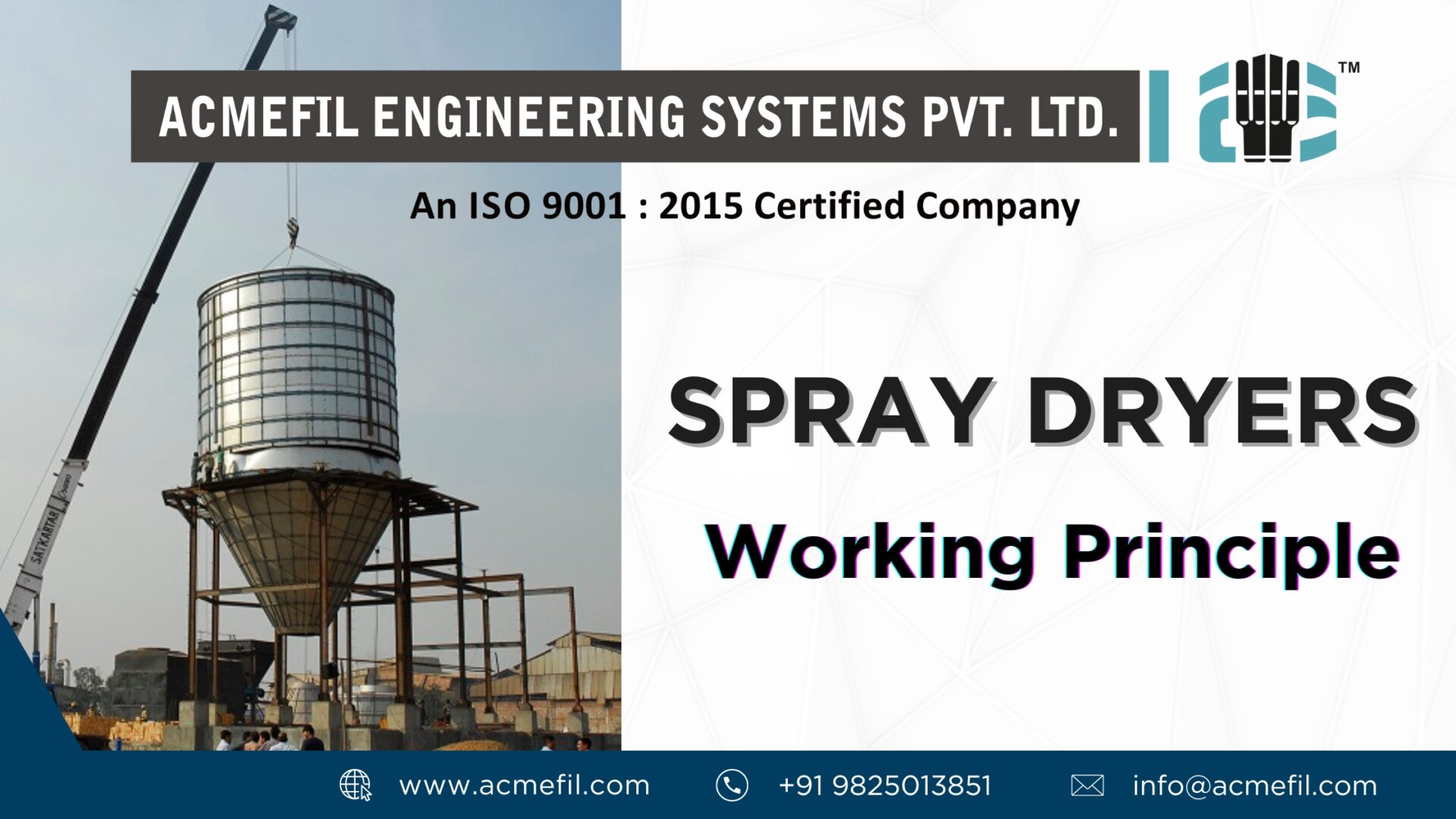
At Acmefil, India’s leading spray dryer manufacturer, we are committed to providing cutting-edge technology and superior quality. Understanding the spray dryer working principle is crucial for optimizing processes in industries such as food, pharmaceuticals, and chemicals. Let’s explore how a spray dryer operates and the many benefits it offers.
Key Highlights
Here’s a quick look at what you’ll learn about spray drying technology:
- Spray drying is a single-step process that transforms liquids into a dried powder.
- An atomizer breaks the liquid feed into fine droplets inside a drying chamber.
- Hot air is introduced into the chamber to rapidly evaporate moisture from the droplets.
- The final product is a consistent, free-flowing dried powder.
- This technology is crucial in many sectors, including the food industry and pharmaceuticals.
- The process allows for precise control over the final particle characteristics.
Introduction
Have you ever wondered how products like instant coffee or milk powder are made? The answer often lies in spray drying technology. This innovative drying process is designed to convert a liquid solution or slurry into a dry powder in just one step. It offers remarkable control over the final product’s properties, including its particle size, moisture content, and shape. As a highly efficient and versatile method, spray drying has become a cornerstone of modern manufacturing across various industries.
Understanding Spray Dryers and Their Importance in Modern Industries
A spray dryer is an essential piece of industrial equipment that executes this unique drying process. It is the go-to solution when you need to create a product in powder form directly from a liquid, offering speed and consistency that other methods can’t match.
The importance of spray dryers is evident across many fields. The food industry relies on them for everything from infant formula to flavorings. Likewise, the pharmaceutical industry uses them to produce stable, easy-to-handle active ingredients. You’ll also find them in the chemical, agricultural, and biotechnology sectors.
What Is a Spray Dryer?
So, what exactly is a spray dryer? In simple terms, it’s a machine that dries liquids by turning them into a fine mist and then exposing that mist to hot gas. This process happens inside a large, specially designed drying chamber.
The core function of a spray dryer is to achieve this liquid-to-solid transformation almost instantly. A liquid feed is pumped into the machine and atomized into millions of tiny droplets. As these droplets travel through the chamber, they encounter a stream of hot air, which causes the liquid to evaporate.
What’s left behind is a dry powder, which is then collected from the system. This single-step operation is what makes spray dryers so efficient. You start with a liquid and end with a ready-to-package dry powder, all within one continuous process.
Key Features of Spray Dryers
Spray dryers come with several key features that contribute to their effectiveness and popularity. The atomizer is at the heart of the system, responsible for breaking the liquid into fine droplets. This component is critical for achieving efficient drying.
Another essential feature is the use of hot air, or a drying gas, which provides the energy needed for rapid evaporation. The design of the system ensures this happens quickly and gently, which is a major advantage. This allows for the processing of even heat-sensitive materials without degrading them.
Here are some of the main benefits offered by these features:
- Rapid and Efficient Drying: The process is extremely fast, often completed in seconds.
- Precise Control: You can control the final particle size distribution, density, and moisture content.
- Versatility: Spray dryers can handle a wide variety of liquid feeds.
- High-Quality Product: The process produces a uniform, free-flowing powder.
How Spray Drying Works: The Basic Principle
The basic principle behind the spray drying process is remarkably straightforward. It all comes down to creating a massive surface area for evaporation to occur. By turning a liquid into millions of atomized droplets, the process dramatically increases the surface area exposed to heat.
These droplets are sprayed into a drying chamber where they mix with hot air. This contact triggers rapid heat and mass transfer, causing the solvent (usually water) to evaporate from the droplets almost instantly. As the liquid evaporates, a solid particle forms and falls to the bottom of the chamber for collection.
Step-by-Step Spray Dryer Working Explained
Let’s break down how a spray dryer works into a few simple steps. The journey from liquid to powder is a carefully controlled sequence of events designed for maximum efficiency.
First, the liquid feed material is prepared and pumped to the atomizer. The atomizer, which can be a spinning disk or a nozzle, breaks the liquid into a fine spray of droplets. These droplets are then dispersed into the drying chamber.
Inside the chamber, the droplets are met with a stream of hot air. This is where the magic happens. The heat causes the liquid in the droplets to evaporate very quickly, leaving behind solid, dry particles. The drying rate is carefully managed by controlling the temperature and airflow. Finally, the dry particles are separated from the air and collected.
- Feed preparation and pumping
- Atomization of the liquid feed
- Drying of droplets with hot air
- Separation and collection of the final powder
The Science Behind Spray Dryer Working Principle
The science of spray drying is centered on the principles of heat and mass transfer. The process’s high efficiency comes from atomization, which creates an enormous surface area from a small volume of liquid. Think of it like this: a single drop of liquid, when atomized, can become millions of tiny droplets, each with its own surface.
This huge surface area allows for incredibly rapid moisture evaporation. When the droplets come into contact with the hot drying gas, a rapid exchange occurs. Heat transfer from the air to the droplet provides the energy for the liquid to turn into vapor.
Simultaneously, mass transfer happens as the moisture moves from the droplet into the surrounding air. This entire sequence of atomization, heat transfer, and mass transfer leads to quick particle formation, transforming the liquid spray into a dry powder in a matter of seconds.
Essential Components of a Spray Dryer System
A functional spray dryer system is made up of several critical components working in harmony. The main parts include a feed pump, an atomizer, a hot air supply unit, a drying chamber, and a cyclone separator for product collection.
Each component has a specific job, from introducing the liquid to collecting the final powder. Understanding these parts will give you a clearer picture of how the entire system operates. Let’s look at some of the most important components in more detail.
Atomizer: Creating Fine Droplets
The atomizer is arguably the most crucial component of a spray dryer. Its job is to break down the liquid feed into a spray of very fine droplets. This step is what makes rapid drying possible.
There are different types of atomizers, with the most common being rotary atomizers and pressure nozzles. Rotary atomizers use a high-speed spinning wheel to fling the liquid outwards, creating a spray of uniform droplets. This type is very versatile and can handle a wide range of materials, including more viscous liquids.
Pressure nozzles, on the other hand, force the liquid through a small opening at high pressure. As the liquid exits the nozzle, it expands and breaks up into atomized droplets. The choice between these types depends on the feed material and the desired characteristics of the final powder.
Hot Air Supply: Role in Efficient Drying
The hot air supply system is responsible for providing the energy needed for drying. A heater raises the temperature of the incoming air, or drying gas, before it enters the drying chamber. This temperature is carefully controlled to ensure optimal drying without damaging the product.
The use of hot air is key to achieving rapid drying. The high temperature of the air stream creates a large temperature difference between the air and the droplets, which drives fast evaporation. This allows the drying process to be completed in seconds, which is especially important for heat-sensitive materials.
Despite the high inlet air temperature, the product itself remains at a much lower temperature due to the cooling effect of evaporation. This ensures high thermal efficiency and protects the product’s quality, flavor, and nutritional value. The flow and temperature of the air are critical parameters that are adjusted to achieve the desired results.
Cyclone Separator and Product Collection
Once the droplets have been dried into a powder, the next step is to separate the product from the air. This is where the cyclone separator comes in. This device uses centrifugal force to separate the solid particles from the exhaust air.
As the air and powder mixture enters the cyclone, it spins in a vortex. The heavier dried powder particles are thrown against the outer wall of the cyclone and slide down to a collection point at the bottom. The lighter exhaust air, now free of most particles, exits from the top of the cyclone.
This separation is vital for both product recovery and environmental protection. An efficient cyclone separator ensures that a high percentage of the dried powder is collected, maximizing yield and product quality. Some systems may also use bag filters to capture any remaining fine particles from the exhaust air.
The Core Steps in the Spray Drying Process
The entire spray drying process can be broken down into four essential steps. It starts with preparing the feed liquid and ends with collecting the finished dried product. Each stage is critical to achieving a high-quality powder with the desired characteristics.
The main steps are: preparing the feed, atomization of the liquid, drying within the drying chamber, and finally, separation and recovery of the powder. Let’s explore each of these steps to see how they contribute to the final outcome.
Preparation of Feed Liquid
The first step in the spray drying journey is the preparation of the feed liquid. This involves getting the feed material into a state that can be easily pumped and atomized. The feed can be a solution, suspension, or paste.
During preparation, you might need to mix components, adjust viscosity, or homogenize the mixture. The goal is to create a uniform liquid that will flow smoothly. Once prepared, a specialized feed pump transports the liquid to the atomizer. The pump ensures a consistent flow rate, which is a critical parameter for controlling the drying process.
Proper feed preparation is key to a successful operation. It directly impacts:
- The efficiency of atomization
- The final particle size
- The overall quality of the dried powder
- The stability of the drying process
Different liquid solutions will require different preparation methods, but the objective is always to create a stable and pumpable feed material.
Atomization and Interaction with Hot Air
Atomization is where the liquid feed is transformed into a fine spray of tiny droplets. This is achieved using either a nozzle or a rotary atomizer, which breaks up the liquid stream by overcoming its surface tension. This step is fundamental because it creates the massive surface area needed for rapid drying.
As soon as the droplets are formed, they are introduced into the drying chamber and come into contact with a stream of hot air. This immediate interaction is what drives the drying process. The heat from the air quickly transfers to the droplets, providing the energy for the liquid to evaporate.
The size of the droplets and the temperature of the hot air are two of the most important factors that determine the drying rate. Smaller droplets and hotter air lead to faster drying. This interaction is carefully controlled to produce a powder with the desired moisture content and particle characteristics.
Drying Chamber: Liquid to Powder Transformation
The drying chamber is the main vessel where the transformation from liquid to powder takes place. It is a large, enclosed space designed to provide enough residence time for the droplets to dry completely before they hit a surface.
Inside the chamber, the atomized droplets are dispersed into the flow of hot air, facilitating rapid drying. The hot air provides the necessary heat for moisture evaporation, turning each droplet into a solid particle. This all happens in a single step, making the process incredibly efficient.
The size and shape of the drying chamber are designed based on the type of atomizer used and the desired airflow pattern. For example, dryers with rotary atomizers are typically wider to accommodate the radial spray pattern. The goal is to ensure that the dry particles are formed mid-air and can be easily collected.
Separation and Recovery of Dried Product
After the drying is complete, the final step is to separate and collect the dried product. The majority of the dried solid particles, now in powder form, fall to the bottom of the chamber, where they can be collected.
However, some of the finer particles are carried away with the exhaust air. To recover these particles and ensure high yield, the air is passed through a separation system. Most commonly, a cyclone separator is used. The cyclone spins the air at high speed, causing the heavier solid particles to be thrown against the walls and collected, while the clean air exits from the top.
This recovery stage is crucial for maximizing efficiency and maintaining product quality. Proper separation ensures that you collect as much of the final powder as possible while also preventing the release of particles into the atmosphere.
Types of Spray Dryers Used in India
Spray dryers come in various designs to suit different applications and materials. The choice of dryer often depends on the type of atomizer used, such as rotary atomizers or pressure nozzles. Each offers unique advantages for controlling particle size and handling different feed viscosities.
Additionally, spray dryers can be classified based on how they handle the drying medium. The two main configurations are open-cycle systems, which are the most common, and closed-cycle systems, which are used for specialized applications. Understanding these types will help you select the right equipment for your needs.
Rotary Atomizer Spray Dryers
Rotary atomizer spray dryers are known for their flexibility and are one of the most widely used types. They use a high-speed spinning wheel to disperse the liquid feed into a spray of fine, uniform droplets. This method provides excellent control over the particle size distribution.
A key advantage of rotary atomizers is their ability to handle a wide range of feed materials, including those with higher viscosities or abrasive slurries. The feed rate can be adjusted to control the drying process and the characteristics of the final powder.
The rapid drying achieved with this type of atomizer makes it suitable for a vast number of products. The uniform droplets created by the spinning wheel ensure a consistent drying process, resulting in a high-quality powder with good flow properties.
Nozzle Atomization Spray Dryers
Nozzle atomization spray dryers use pressure nozzles to create the spray. In this setup, the liquid feed is pumped at high pressure through a small orifice. As the liquid exits the nozzle, the pressure drop causes it to break apart into atomized droplets.
This type of dryer is excellent for producing a powder with a very consistent and often narrow particle size distribution. The food and dairy industries frequently use pressure nozzles to create products with specific flow properties and bulk densities.
The drying rate and final particle size can be controlled by adjusting the pump pressure and the nozzle design. While they may be less suitable for highly viscous or abrasive feeds compared to rotary atomizers, nozzle atomizers are highly effective for producing homogenous powders from solutions and low-viscosity suspensions.
Closed-Cycle and Open-Cycle Systems
Spray dryers can be configured as either open-cycle or closed-cycle systems. Open-cycle systems are the most common. They draw in fresh air, heat it, use it as the drying gas, and then release the exhaust air into the atmosphere after cleaning.
Closed-cycle systems, on the other hand, operate in a closed loop. The drying gas, often an inert gas like nitrogen, is recycled continuously. This design is used when processing sensitive products that could oxidize in air or when drying liquids that use flammable organic solvents. The closed loop allows for solvent recovery, which is both economical and environmentally friendly.
Here’s a simple comparison:
| Feature | Open-Cycle System | Closed-Cycle System |
|---|---|---|
| Drying Gas | Air drawn from the atmosphere | Recycled inert gas (e.g., Nitrogen) |
| Application | General purpose, water-based feeds | Flammable solvents, oxygen-sensitive products |
| Solvent | Vented to the atmosphere | Recovered and reused |
| Cost | Lower initial and operational cost | Higher initial cost, but allows solvent recovery |
Materials Commonly Processed with Spray Dryers
The versatility of spray drying makes it suitable for an incredibly wide range of materials. From everyday food ingredients to highly specialized chemicals, this technology is used to produce powders across numerous industries.
Common products include milk powder, instant coffee, and egg powders in the food sector. In pharmaceuticals, it’s used for active pharmaceutical ingredients and excipients. The technology is also applied to agricultural products, detergents, pigments, and even materials for advanced batteries. Let’s look at some of these applications more closely.
Food and Dairy Applications
The food industry is one of the largest users of spray drying technology. The process is ideal for converting liquid food products into a stable powder form, which extends shelf life and makes transportation easier.
You encounter spray-dried products every day. Milk powder is a classic example, where liquid milk is dried to create a long-lasting product. The food processing sector also uses spray drying for creating instant coffee, tea, fruit juices, and flavorings. The gentle drying process helps preserve the taste, aroma, and nutritional value of the ingredients.
Here are just a few examples of products made using spray drying in the food industry:
- Infant formula
- Whey and cheese powders
- Egg products
- Soup mixes
- Yeast extracts
Use in Pharmaceuticals and Chemicals
In the pharmaceutical industry, spray drying plays a critical role in drug manufacturing. It is used to produce a dry powder from liquid formulations, which is often a necessary step for creating tablets, capsules, or dry powder inhalers.
The process is particularly valuable for producing active pharmaceutical ingredients (APIs). It allows for precise control over particle size and morphology, which can improve the solubility and bioavailability of poorly soluble drugs. Because the process is so fast, it can be used to dry sensitive materials like enzymes, proteins, and vaccines without significant loss of activity.
Control over the final moisture content is also a key benefit, as it helps ensure the stability of the final drug product. From excipients to complex drug delivery systems, spray drying is an indispensable tool in modern pharmaceutical development and manufacturing.
Agricultural, Environmental, and Specialty Uses
Beyond food and pharma, spray drying has found a home in many other sectors. In agriculture, it is used to produce animal feed, fertilizers, and pesticides in a convenient powder form. The process creates dried particles that are easy to handle, mix, and distribute.
Environmental applications for spray drying include the treatment of wastewater and industrial effluent. The technology can be used to concentrate waste streams, recovering valuable materials or reducing the volume of waste for disposal.
There are also exciting specialty uses. For example, spray drying is becoming a key process in the production of materials for lithium-ion batteries. It is used to create powders with specific properties, such as high surface area, which are essential for improving battery performance. This shows just how adaptable the technology is to new and emerging fields.
Advantages and Limitations of Using Spray Dryers
Like any technology, spray drying has its own set of advantages and limitations. The benefits, such as rapid drying and high efficiency, have made spray drying technology a popular choice for many industries, especially for processing sensitive materials.
However, it’s also important to be aware of the process limitations. These can include high initial costs and challenges with certain types of feed materials. Understanding both sides will help you determine if spray drying is the right solution for your application.
Key Benefits of Spray Drying Technology
Spray drying offers several significant benefits that set it apart from other drying methods. One of the most important is the speed of the process. The rapid drying time, often just a few seconds, is ideal for high-throughput production.
Another major advantage is its suitability for heat-sensitive materials. Although the drying air is hot, the product itself stays at relatively lower temperatures due to evaporative cooling. This helps preserve the quality and activity of substances like proteins, enzymes, and vitamins.
Here are some of the key benefits you can expect:
- Continuous Process: Spray drying is a continuous process that can be easily automated and scaled up.
- Particle Engineering: It offers excellent control over particle size, density, and morphology.
- High Product Quality: The process produces a uniform, free-flowing powder with consistent properties.
- Versatility: It can be used for a wide range of products, from food ingredients to advanced ceramics.
Challenges and Considerations in Spray Drying
Despite its many advantages, spray drying does come with some challenges. One of the main process limitations is the feed viscosity. The technology typically works best with liquids that have a relatively low viscosity, as highly viscous materials can be difficult to atomize.
Another consideration is the high capital cost. Spray dryers are large, complex pieces of equipment, and the initial investment can be substantial. They also consume a significant amount of energy to heat the air and run the system, which can lead to high operating costs, especially for large-scale operations.
Finally, ensuring operational safety is critical, as many dry powders can be explosive. Systems must be designed with appropriate safety measures, such as explosion protection. While these challenges exist, modern innovations and working with experienced manufacturers can help mitigate these issues effectively.
Comparing Spray Dryers with Other Industrial Drying Methods
How does the spray drying method stack up against other industrial drying techniques? While there are many ways to remove moisture from a product, each has its own strengths and weaknesses. The best choice depends on your product, your budget, and your quality requirements.
Two common alternatives are freeze drying and conventional heat drying methods like tray or drum dryers. Comparing spray drying to these alternatives highlights its unique advantages in terms of speed, cost, and final product characteristics. Let’s examine these differences.
Differences Between Spray Drying and Freeze Drying
Spray drying and freeze drying are two very different processes used for drying sensitive materials. The main difference lies in how moisture is removed. Spray drying uses hot air for rapid moisture evaporation, while freeze drying involves freezing the material and then removing the ice through sublimation under a vacuum.
Freeze drying is an extremely gentle process and is often considered the gold standard for preserving the structure of very delicate biological materials. However, it is a much slower and more expensive batch process compared to the continuous operation of a spray dryer.
Here’s a quick comparison:
- Speed: Spray drying is very fast (seconds), while freeze drying is very slow (hours or days).
- Cost: Spray drying is generally less expensive in terms of both capital and operating costs.
- Process: Spray drying is a continuous, single-step process from liquid to powder. Freeze drying is a multi-step batch process.
- Particle Form: Spray drying produces spherical particles, while freeze-dried products typically have a more porous, cake-like structure.
Spray Drying vs. Conventional Heat Drying Methods
Conventional heat drying methods, such as tray, belt, or drum dryers, rely on conduction or convection to heat a solid or semi-solid material over a longer period. This is quite different from the spray drying approach, which starts with a liquid and uses atomization to create a massive surface area for drying.
This difference in surface area is key to the higher process efficiency of spray drying. By drying tiny droplets in a hot drying medium, spray drying achieves a much faster drying rate. Conventional methods are slower and can sometimes lead to uneven drying or thermal degradation of the product due to prolonged exposure to heat.
While conventional heat drying can be simpler and cheaper for certain bulk solids, the spray drying process offers superior control over the final dry product’s characteristics, such as particle size and flowability. It transforms a liquid directly into a finished powder in a single, rapid step.
Innovations in Spray Dryer Technology in the Indian Market
The field of spray drying technology is constantly evolving, with new innovations aimed at overcoming its traditional limitations. In the Indian market, there is a strong focus on improving energy efficiency, increasing automation, and enhancing product quality and safety.
These advancements are making spray dryers more cost-effective, reliable, and safer to operate. By addressing challenges like high energy consumption and the need for skilled operators, modern spray dryers are becoming an even more attractive solution for a wide range of industries.
Energy Efficiency and Automation Trends
Improving energy efficiency is a major trend in modern spray dryer design. Manufacturers are developing systems with better thermal efficiency to reduce heat loss and lower energy consumption. This can involve better insulation, heat recovery systems, and more efficient air heaters.
Automation is another key area of innovation. Modern spray dryers are equipped with advanced process control systems that can automatically regulate parameters like inlet temperature, feed flow rate, and airflow. This leads to a more consistent product and reduces the need for constant manual supervision.
These automated systems can optimize the drying process in real-time, ensuring the highest possible efficiency and product quality. This not only lowers operating costs but also makes the technology more accessible and easier to manage for a wider range of users.
Developments in Product Quality and Safety
Recent developments in spray dryer technology have also focused on improving product quality and safety. For sensitive materials, new designs are being created to offer even gentler drying conditions, better preserving the activity and integrity of the final product.
Innovations in atomizer design are leading to better control over the size and uniformity of the dried particles, which is critical for product quality in many applications. Improved thermal efficiency also means a more controlled drying environment, further protecting the product from heat damage.
Safety is a top priority, especially when dealing with potentially explosive powders. Modern systems incorporate advanced safety features, such as explosion protection and fire suppression systems. These measures are designed to safely manage any risks, ensuring a secure operating environment for both personnel and the facility.
Selecting and Customizing Spray Dryers for Indian Industry Needs
Choosing the right spray dryer for your business is a critical decision. With the diverse industrial needs in India, from food and dairy to pharmaceuticals and chemicals, a one-size-fits-all approach rarely works. The ideal spray dryer depends on your specific product, production scale, and quality requirements.
Fortunately, leading manufacturers offer custom solutions that can be tailored to your unique process parameters. By working with an expert, you can design a system that maximizes efficiency and delivers the exact product characteristics you need.
Factors Influencing Equipment Choice
Several factors will influence your choice of a spray dryer. The first is the nature of your feed material—its viscosity, solids content, and heat sensitivity will all play a role in determining the right design.
You also need to consider your desired output. What are your goals for the final product quality? This includes the target particle size distribution, residual moisture content, and bulk density. Your required production capacity, or feed rate, will determine the overall size of the system.
Here are some key factors to consider:
- Feed Properties: Viscosity, solids content, and heat sensitivity.
- Product Specifications: Desired particle size, moisture, and density.
- Production Capacity: The required throughput or feed rate.
- Drying Medium: Whether you need an open-cycle or closed-cycle system.
- Level of Automation: The degree of process control required.
Custom Solutions by Top Manufacturers Like Acmefil
To navigate these choices, it’s best to partner with an experienced manufacturer. As a top spray dryer manufacturer in India, Acmefil specializes in providing custom solutions tailored to the specific needs of different industries. We understand that the requirements for food processing are different from those of the pharmaceutical industry.
By leveraging the latest advancements in spray drying technology, we design systems that deliver optimal performance and high product quality. Whether you need to produce milk powder, encapsulate active ingredients, or create specialty chemicals, our team can help you develop the perfect drying solution.
Working with a manufacturer like Acmefil ensures that your spray dryer is not just a piece of equipment, but a fully integrated part of your production process. We provide the expertise to help you achieve your goals efficiently and reliably, ensuring a strong return on your investment.
Conclusion
In conclusion, understanding the working principle of spray dryers is essential for anyone involved in industries that rely on liquid-to-powder transformation. These innovative machines are not just about drying; they represent a critical technology that enhances product quality and efficiency across various sectors, from food processing to pharmaceuticals. By being aware of the components and steps involved in spray drying, you can make informed decisions when selecting the right system for your needs. As the industry evolves with new advancements, keeping updated on these innovations will position your business for success. If you’re looking for tailored solutions or further insights on spray dryer technology, reach out to us for more information!
Frequently Asked Questions
Can you explain the spray dryer working principle in simple terms?
In a spray dryer, a liquid is sprayed through an atomizer to create fine droplets inside a drying chamber. A stream of hot air is then used to rapidly evaporate the moisture from these droplets. This process instantly transforms the liquid into a dry powder, which is then collected.
What products are best suited for spray drying?
Spray drying is ideal for a wide range of products, especially in the food and pharmaceutical industry. Common examples include milk powder, instant coffee, and various food ingredients. It is also perfect for heat-sensitive materials like enzymes, proteins, and active pharmaceutical ingredients due to the rapid and gentle drying process.
What are the main advantages of using spray dryers over other drying techniques?
The main advantages of spray dryers include extremely rapid drying, the ability to process materials at lower effective product temperatures, and operation as a continuous process. They also offer excellent control over final product quality, including precise management of particle size, shape, and density, which is difficult to achieve with other methods.
Why Choose Acmefil?
At Acmefil, we blend expertise with innovation to offer state-of-the-art spray dryers. Our commitment to quality ensures you receive equipment tailored to your specific needs. With extensive experience and dedication to customer satisfaction, Acmefil is the top choice for spray drying solutions.
Conclusion
Understanding the spray dryer working principle is essential for selecting the right equipment for your needs. With Acmefil’s advanced technology and reliable performance, you can achieve efficient and high-quality drying results. Contact us today to learn more about our spray dryers and how they can benefit your production process.
By choosing Acmefil, you opt for excellence in spray drying technology. Explore our range of products and discover how we can help you achieve your production goals with efficiency and precision.
For more information, visit our website or reach out to our expert team at Acmefil. We are here to support you in finding the best spray drying solutions for your business.