

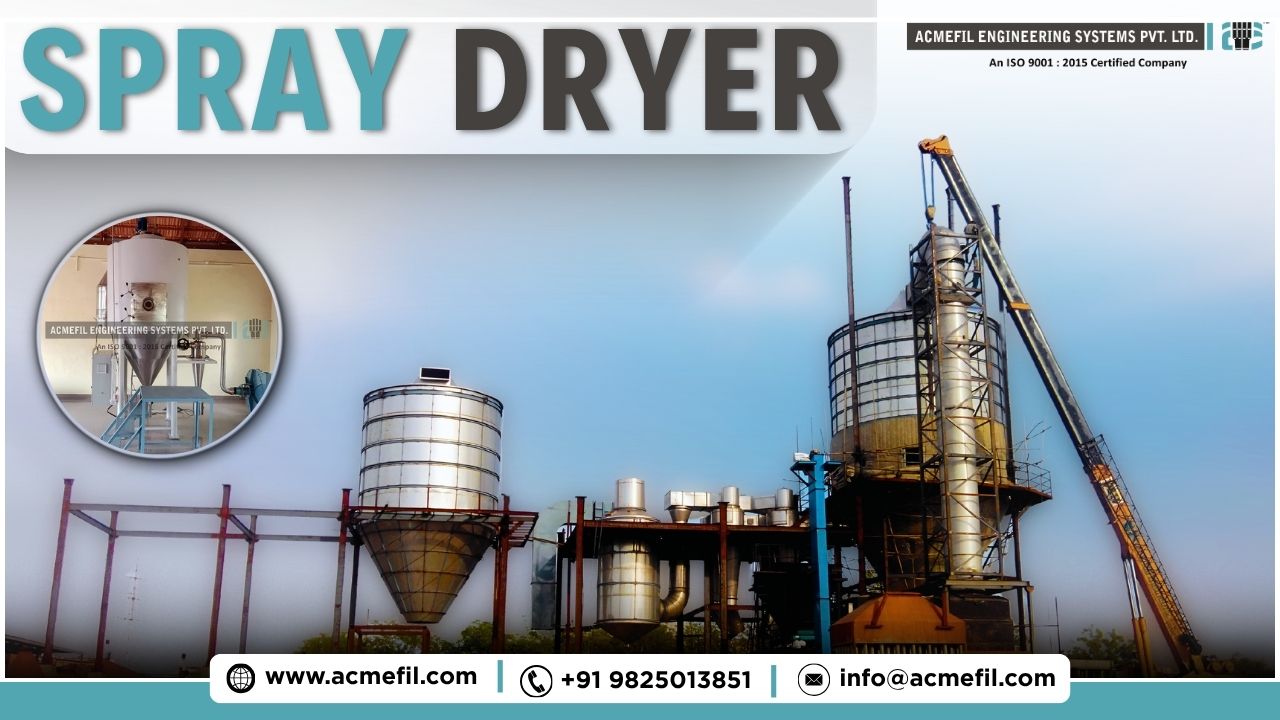
Key Highlights
- The spray drying process efficiently turns liquids into a dried powder in a single step.
- Atomization is key, creating fine droplets that are dried quickly in a drying chamber with hot gas.
- Spray drying is widely used in the food industry for products like milk powder and instant coffee.
- This technology allows for precise control over final product qualities like particle size and moisture content.
- It is an ideal method for preserving sensitive ingredients due to the rapid drying time.
Introduction
Have you ever wondered how liquid food products like milk are transformed into a stable powder form? The secret is a remarkable process known as spray drying. This technology is a game-changer, converting solutions and suspensions into powders with specific characteristics in just one step. It’s an elegant and efficient method used across many industries. As a leading spray dryer manufacturer, Acmefil Engineering System Private Limited has perfected this process, making it possible to create high-quality powders from a wide range of liquids.
Understanding Spray Dryer Powder
Spray dryer powder is the final product created when a liquid feed is rapidly dried into a solid. This process is essential in the food industry and for creating pharmaceuticals, as it can handle even sensitive products without degrading them.
The resulting dried powder is known for its uniform particle size distribution and free-flowing nature, making it easy to package and handle. Gaining a deeper understanding of this powder’s characteristics reveals why this technology is so valuable.
Definition and Characteristics of Spray Dryer Powder
So, what exactly is spray dryer powder? It is a substance in powder form produced from a liquid through the spray drying process. This technique involves atomizing a liquid feed into tiny droplets and then exposing them to a hot gas. The liquid evaporates almost instantly, leaving behind solid particles.
These powders have distinct characteristics. They typically feature a fine, porous structure with a high specific surface area. This quality makes them highly soluble and easy to wett, which is a major advantage for products that need to be reconstituted in water, like instant drinks.
The particle size can be precisely controlled during the process, ranging from 5 to 200 µm. This control allows for the tailoring of powder properties to meet specific application needs, from flowability to bulk density. The final particles can be homogeneous, hollow, or a mix of structures depending on the process parameters.
Key Physical and Chemical Properties
Several key properties define the quality and functionality of a dried powder. One of the most critical is moisture content. Controlling residual moisture is essential for ensuring the stability and shelf life of the final product, preventing caking and microbial growth.
Other important physical properties include flowability and bulk density. Good flowability ensures that the powder can be handled, transported, and packaged efficiently without clumping. Bulk density affects packaging volume and dosage accuracy. These properties are influenced by particle size, shape, and surface characteristics.
Chemically, the glass transition temperature (Tg) is a significant factor. This is the temperature at which the powder transitions from a rigid, glassy state to a rubbery one, which can cause stickiness. To avoid processing and storage issues, the outlet temperature during drying should remain below the product’s Tg.
Comparison With Other Powder Production Methods
When it comes to powder production, spray drying stands out among other drying techniques. Unlike methods that require multiple stages, such as dewatering followed by fluid bed drying, spray drying converts a liquid into a powder in a single, continuous step. This simplicity can reduce capital costs, especially for smaller production plants.
While spray drying can have higher energy consumption due to the heat transfer required for rapid evaporation, its efficiency and speed often make it more cost-effective overall. Other methods like freeze-drying are significantly slower and more expensive, although they are also excellent for preserving sensitive materials.
The choice between different drying technologies depends on the desired product properties and process parameters. Here’s a quick comparison of common powder production methods:
| Feature | Spray Drying | Freeze-Drying | Multi-Step Drying |
|---|---|---|---|
| Process Speed | Very fast (seconds) | Very slow (hours to days) | Moderate to slow |
| Process Steps | Single step | Multiple steps | Multiple steps |
| Energy Consumption | High | Very high | Moderate |
| Product Form | Fine, spherical powder | Porous, non-uniform cake | Granules or crystals |
The Science of Spray Drying
The transformation from liquid to powder through spray drying is a fascinating scientific process. It all hinges on the principles of heat transfer and mass transfer, which occur in a matter of seconds. A feed pump delivers the liquid material to an atomizer, which creates a fine spray.
This spray is then introduced into a stream of hot drying gas. The carefully controlled drying conditions ensure that the liquid evaporates rapidly without damaging the solid components. We’ll explore the fundamental principles and steps that make this technology so effective.
Fundamental Principles of Spray Drying
At its core, spray drying is about creating a massive surface area for rapid evaporation. This is achieved through atomization, the process of breaking the liquid feed into millions of tiny droplets. These droplets are then dispersed into a stream of hot air or another heated gas.
The high temperature of the drying gas causes the moisture in the droplets to evaporate almost instantly. Because the residence time in the drying chamber is extremely short—often just a few seconds—the particles themselves don’t overheat. This rapid, gentle drying is what makes the process suitable for heat-sensitive materials.
The final particle size and structure of the powder are determined by the initial droplet size created during atomization and the drying conditions. By controlling these factors, you can engineer a powder with specific properties, such as high porosity or excellent solubility.
Step-by-Step Spray Drying Process Overview
The spray drying process is a continuous operation that can be broken down into a few key steps. It begins with preparing the liquid feed, which could be a solution, suspension, or emulsion. This liquid is then transformed into a free-flowing powder.
The entire drying process happens in a single, streamlined operation. The key is how quickly the fine droplets are formed and dried, resulting in the final dried powder. Here’s a simple breakdown of the journey from liquid to solid:
- Feed Preparation: The liquid material is prepared to have the correct viscosity and solids concentration.
- Atomization: The liquid is pumped to an atomizer, which breaks it into fine droplets.
- Drying: These droplets are sprayed into the drying chamber, where they mix with a hot drying gas, causing rapid evaporation.
- Separation: The dried powder is separated from the moist gas stream, typically using a cyclone or bag filter.
Finally, the dried powder is collected from the bottom of the system, ready for packaging or further processing. The exhaust gas is filtered to capture any remaining fine particles before being released.
Role of Temperature, Pressure, and Airflow
Controlling process variables is crucial for successful spray drying. Temperature plays a major role. The inlet temperature, which is the temperature of the hot air stream entering the dryer, is typically very high (200-250°C) to provide enough energy for rapid evaporation.
The outlet temperature, or the temperature of the exhaust air, is much lower and is an indicator of the final product’s moisture content. A lower outlet temperature usually means the product is moister. This temperature is controlled by adjusting the liquid feed flow rate.
Airflow and pressure are also critical. The flow rate of the air stream determines the residence time of particles in the dryer. If a nozzle atomizer is used, high pressure is applied to the liquid feed to create the spray. Precise control over these parameters ensures consistent product quality and efficient operation.
Liquid to Powder Conversion Explained
The magic of spray drying lies in its incredibly fast liquid-to-powder conversion, which happens in a single step. The process is a perfect example of efficient heat and mass transfer. When the atomized droplets meet the hot drying medium, a significant temperature difference drives rapid evaporation.
Moisture moves from the droplet’s interior to its surface and then into the surrounding gas. As the liquid evaporates, the solids are left behind, forming dried particles. The entire transformation from a liquid droplet to a solid particle can occur in fractions of a second.
The initial droplet size is a key factor, as smaller droplets have a larger surface-area-to-volume ratio, allowing them to dry faster. This rapid process “locks in” the properties of the material, often creating porous, lightweight particles that are easy to dissolve.
Types of Spray Dryer Equipment
Not all spray dryers are the same. The “heart” of the spray drying process is the atomizer, and different types are used depending on the product requirements. The choice of atomizer, such as rotary atomizers or various nozzle atomizers, directly impacts the final powder’s characteristics.
Whether you need a narrow particle size distribution for pharmaceuticals or you’re working with a high-viscosity slurry for food production, there’s a specific spray dryer design suited for the task. Understanding these designs is key for product development and process optimization.
Rotary Atomizer Spray Dryers
Rotary atomizers, also known as centrifugal atomizers, are one of the most flexible and widely used types in spray drying. This system uses a high-speed spinning wheel or disc to atomize the liquid feed. The liquid is fed to the center of the wheel and flung outwards by centrifugal force, breaking up into fine droplets.
One of the main advantages of rotary atomizers is their ability to handle a wide range of feed materials, including high-viscosity and abrasive slurries. They produce a spray of droplets that are ejected radially into the drying chamber, which requires a large-diameter chamber to prevent wet particles from hitting the walls.
This method is known for its high efficiency and ability to produce large quantities of product. While rotary atomizers typically create a wider particle size distribution compared to nozzles, the resulting powder is often uniform and free-flowing.
Nozzle Atomizer Spray Dryers
Nozzle atomizers use high pressure to force the liquid feed through a small orifice, causing it to break apart into small droplets. A feed pump delivers the liquid to the nozzle at pressures that can reach up to 300 bar. This method is a cornerstone of modern spray drying technology.
This type of atomization is excellent for producing a powder with a very consistent and narrow particle size distribution. This precision is often required in the food and dairy sectors to achieve good flow properties and consistent bulk density in products like milk powder.
The spray from a pressure nozzle is typically a cone shape, which allows for the use of taller, narrower drying chambers compared to those used with rotary atomizers. However, these nozzles are more prone to clogging, especially with viscous or particulate-containing feeds.
Two-Fluid Nozzle Spray Dryers
Two-fluid nozzle spray dryers, sometimes called pneumatic nozzles, use a different principle for atomization. In this design, the liquid feed is combined with a high-velocity stream of compressed gas, usually air or steam. The energy of the gas shatters the liquid into very fine droplets.
This type of nozzle operates at a much lower liquid pressure compared to pressure nozzles. The two fluids—the liquid feed and the atomizing gas—meet in a small chamber where the shearing action creates the spray. This allows for excellent control over the final droplet size.
Two-fluid nozzles are very versatile and can handle more viscous feeds than pressure nozzles. They are often used in laboratory-scale and pilot dryers due to their flexibility and ability to produce very fine powders. The droplet size can be adjusted by changing the ratio of liquid to gas flow.
Comparison of Different Spray Dryer Designs
Choosing the right spray dryer design is critical to achieving the desired product quality. The decision depends on your unique product requirements, the properties of your liquid feed, and the necessary process conditions. Each atomizer type offers different advantages for the spray drying process.
Rotary atomizers are robust and versatile, while pressure nozzles offer precision. Two-fluid nozzles provide flexibility, especially on a smaller scale. The equipment design directly influences particle size, density, and flowability.
To help you decide, here’s a comparison of the three main atomizer types based on key operational factors:
| Feature | Rotary Atomizer | Pressure Nozzle | Two-Fluid Nozzle |
|---|---|---|---|
| Atomization Principle | Centrifugal force | High pressure | High-velocity gas |
| Feed Viscosity | Handles high viscosity | Best for low viscosity | Handles moderate viscosity |
| Particle Size Distribution | Broader | Narrow | Adjustable, can be narrow |
| Energy Usage | High | Moderate | High (due to compressed gas) |
| Clogging Risk | Low | High | Low to moderate |
Essential Components of a Spray Drying Plant
An industrial spray drying plant is more than just a drying chamber. It’s a complex system of interconnected equipment, all working in harmony to execute the drying process flawlessly. From feed preparation to powder collection, each component plays a vital role.
A complete system includes equipment for preparing the liquid, atomizing it, drying the particles, and then separating the powder from the air stream. A sophisticated control system manages the entire operation to ensure consistent results. Let’s look at these essential components.
Feed Preparation Systems
The journey of any spray-dried powder begins with the feed preparation system. This is where the raw materials are combined to create the liquid feed that will be dried. This step is crucial, as the properties of the liquid directly impact the efficiency of the drying process and the quality of the final powder.
During feed preparation, ingredients are mixed, and the feed concentration (solids content) and viscosity are adjusted. The order in which raw materials are added can be critical to creating a stable solution or emulsion. The temperature of the slurry can also affect its viscosity and pumpability.
These process parameters must be carefully controlled to ensure the liquid feed is homogeneous and has the right characteristics for atomization. A well-prepared feed is the first step toward a successful spray drying operation and a high-quality final product.
Atomization Units
The atomization unit is the heart of the spray dryer. Its job is to break the liquid feed into a spray of fine droplets, dramatically increasing the surface area for drying. The choice of atomizer, whether it’s rotary atomizers, pressure nozzles, or a two-fluid nozzle, is one of the most important decisions in designing a spray drying process.
This choice directly influences the final droplet size, which in turn determines the particle size of the dried powder. For example, a rotary atomizer will typically produce a wider distribution of particle sizes, while a pressure nozzle can create a narrower, more uniform distribution.
The goal of atomization is to create a consistent spray that allows for uniform and efficient drying. Proper atomization prevents the formation of overly large droplets that may not dry completely, ensuring the final product meets its specifications.
Drying Chambers
The drying chamber is where the transformation from liquid to powder takes place. It is a large, enclosed vessel where the atomized droplets are mixed with hot air or another drying gas. The size and shape of the chamber are designed to provide adequate residence time for the particles to dry completely before they fall or are carried out.
The design of the drying chamber is also important for preventing wet particles from sticking to the chamber walls. For dryers with rotary atomizers, which spray droplets radially, a wide-diameter chamber is necessary. Dryers with nozzles often use taller, narrower chambers.
Efficient heat transfer within the chamber is key to the process. The flow pattern of the hot air—either co-current (same direction as the spray) or counter-current—also affects the temperature profile and drying characteristics of the product.
Powder Recovery and Collection Systems
Once the dried particles are formed in the chamber, they need to be separated from the hot, humid air stream. This is the job of the powder recovery and powder collection systems. Most of the heavier particles fall to the bottom of the dryer’s conical base and are collected there.
However, many of the finer dried particles are carried out of the chamber with the exhaust air. To capture these, a cyclone separator is typically used. The cyclone uses centrifugal force to separate the particles from the gas. In some systems, a bag filter may be used for even higher recovery rates.
An efficient collection system is vital not only for maximizing product yield but also for controlling the properties of the final powder. It ensures that the collected product has the desired flowability and bulk density, ready for its next step.
Factors Affecting Spray Dried Powder Quality
Achieving a high-quality dried powder isn’t just about having the right equipment; it’s about mastering the process. Several factors influence the final product quality, from the characteristics of the raw material to the specific process conditions used during drying.
Key quality indicators include particle size distribution, final moisture content, solubility, and flowability. By understanding and controlling the variables that affect these properties, you can consistently produce a powder that meets your exact specifications. Let’s look at these factors in more detail.
Particle Size Distribution
Particle size distribution is one of the most important characteristics of a spray-dried powder. It affects many other properties, including bulk density, flowability, and solubility. A narrow distribution, where all particles are roughly the same size, is often desirable for consistency.
The primary factor controlling particle size is the initial droplet size created during atomization. The choice of atomizer plays a huge role here. For instance, pressure nozzles tend to create a narrower size distribution than rotary atomizers.
A powder’s form and surface area are directly linked to its particle size. Finer particles have a larger total surface area, which can improve solubility but may also lead to dustiness and poor flow. Controlling the particle size distribution allows you to balance these properties for the ideal final product.
Moisture Content Control
Controlling the final moisture content of the powder is critical for ensuring its quality and stability. If the powder is too moist, it can become sticky, clump together, and be susceptible to microbial growth, which shortens its shelf life. This is especially important for food ingredients.
The residual moisture content is primarily controlled by the drying conditions, particularly the outlet temperature of the dryer. The outlet temperature is a reflection of how much energy was used for evaporation. A higher outlet temperature generally results in a drier product.
This temperature is managed by adjusting the feed rate—a slower feed rate gives each droplet more time and energy to dry, lowering the final moisture content. Precise control is essential to produce a stable, free-flowing powder that will remain in perfect condition during storage.
Solubility and Flowability
For many products, like instant coffee or powdered drinks, solubility is a key measure of quality. Consumers expect the dried powder to dissolve quickly and completely upon reconstitution. Spray-dried powders are often highly soluble due to their porous structure and large surface area.
Flowability is another crucial physical property. It refers to the ability of a powder to flow smoothly and consistently, which is important for handling, dosing, and packaging. Poor flowability can lead to clumping, bridging in hoppers, and inaccurate measurements.
The morphology of the particles, including their size, shape, and surface texture, heavily influences both solubility and flowability. Spherical, uniform particles produced by spray drying tend to have better flow properties than irregularly shaped particles from other drying methods.
Influence of Raw Material and Feed Concentration
The quality of your final product starts with your raw materials. The characteristics of the materials being dried, such as their chemical composition and thermal stability, will dictate many of the required process parameters.
The feed concentration, or the percentage of solids in the liquid feed, is another significant factor affecting powder quality. A higher solids concentration generally results in larger, more porous particles and can increase the throughput of the dryer. However, it also increases the viscosity of the feed, which can make atomization more difficult.
Finding the optimal feed concentration is a balancing act. The goal is to maximize efficiency without compromising the atomization process or the quality of the final product. It is one of the key process parameters that must be optimized during product development.
Main Advantages of Spray Dryers
Why do so many industries rely on the spray drying process? The answer lies in its numerous advantages over other drying techniques. This method is not only fast and efficient but also incredibly versatile, offering precise control over product quality.
From preserving delicate ingredients to ensuring uniform particle shape, spray drying delivers a superior dried powder. The ability to fine-tune process parameters makes it a powerful tool for creating a wide range of products. Let’s explore some of the biggest benefits this technology offers.
High Efficiency in Industrial Production
One of the primary benefits of spray drying is its high efficiency, particularly in large-scale industrial production. The drying process is continuous and very fast, transforming a liquid into a dry powder in seconds. This high throughput makes it a cost-effective solution for manufacturing large volumes.
While the energy consumption for heating the drying air can be high, the single-step nature of the process often offsets this. It eliminates the need for multiple pieces of equipment and additional handling steps that are common in other drying methods, simplifying the overall production line.
This efficiency is also valuable during product development. The speed of the process allows for rapid testing and optimization of formulations and parameters, shortening the time it takes to bring a new product to market.
Uniform Particle Morphology
Spray drying is renowned for its ability to produce particles with a uniform, spherical morphology. This consistency is a major factor in ensuring high product quality. Uniformly shaped particles lead to better flowability, more consistent bulk density, and predictable performance in the final application.
The process offers precise control over particle size and size distribution. By selecting the right atomizer and fine-tuning the operating parameters, you can engineer a dried powder that meets very specific requirements. This level of control is difficult to achieve with many other drying methods.
Whether you need a narrow size distribution for a pharmaceutical application or a specific particle size for a food ingredient, spray drying provides the tools to achieve it. This results in a final product that is not only high-quality but also consistent from batch to batch.
Preservation of Sensitive Ingredients
Many valuable compounds, such as vitamins, enzymes, and proteins, are sensitive to heat. Spray drying technology is exceptionally well-suited for drying these sensitive ingredients without damaging them. How is this possible when the process uses such hot air?
The secret is evaporative cooling. As moisture evaporates from the surface of the droplets, it cools the particle itself. The heat transfer from the hot air is used for evaporation rather than for raising the particle’s temperature. Also, the residence time in the dryer is extremely short.
This gentle drying process helps preserve the activity, flavor, and nutritional value of sensitive food ingredients and pharmaceuticals. The resulting low-moisture powder also has an extended shelf life, protecting the integrity of the active components during storage.
Reduced Contamination Risks
Product safety is a top priority, especially in the food industry and pharmaceutical manufacturing. Spray drying offers significant advantages in this area. Because it is a closed, single step process, the risk of external contamination is greatly reduced compared to multi-stage processes that involve more handling.
The high temperatures used for the drying air also help to minimize microbial contamination. The entire system, from feed tanks to collection cyclones, can be designed for easy cleaning and sanitization, further enhancing product safety.
By carefully controlling the process conditions within the enclosed system, manufacturers can ensure that the final product is pure and safe. This makes spray drying a trusted method for producing ingredients where hygiene and quality are paramount.
Industrial Applications of Spray Dryer Powder
The versatility of spray dryer powder means its applications are incredibly diverse. You can find spray-dried products in almost every major industry, from what you eat to the medicines you take. It has become an essential technology in food processing, pharmaceutical manufacturing, and chemical processing.
This wide range of uses is a testament to the process’s flexibility and its ability to be tailored for specific product development goals. Let’s examine some of the key industries where spray drying plays a critical role.
Food Industry Utilizations
The food industry is one of the largest users of spray drying technology. Many of the powdered food products you see on grocery store shelves are made using this process. It’s the standard method for producing milk powder, whey powder, and infant formula.
The technology is also responsible for creating instant coffee and tea. It preserves the delicate flavors and aromas of these food products while transforming them into a convenient, soluble powder. Other common applications include creating powdered eggs, flavorings, and various food ingredients.
Spray drying is favored in the food industry because it is fast, efficient, and protects the nutritional and sensory qualities of the final product. It allows for the creation of stable, long-lasting products that are easy for consumers to use.
Pharmaceutical Manufacturing
In the pharmaceutical industries, precision and quality are non-negotiable. Spray drying is a vital process for manufacturing a wide variety of products, from active pharmaceutical ingredients (APIs) to excipients. It is used to convert drugs into a stable powder form with controlled properties.
The process is particularly useful for encapsulating sensitive materials or improving the dissolution rate of poorly soluble drugs. By creating amorphous solid dispersions, spray drying can enhance the bioavailability of a medication. It provides excellent control over particle size, moisture content, and flowability, which are critical for tablet manufacturing.
The gentle, rapid drying preserves the potency of sensitive biopharmaceuticals like enzymes, vaccines, and proteins. This makes it an invaluable tool for producing high-quality, effective medications.
Chemical Processing
The chemical processing industry also relies heavily on spray drying. The drying process is used to produce a vast range of materials, including detergents, pigments, catalysts, and ceramics. The ability to create a dried powder with specific physical properties is a major advantage.
For products like detergents, spray drying produces hollow, lightweight granules that dissolve quickly in water. In the production of ceramic materials, it is used to create free-flowing powders from nanoparticle slurries, which are then processed further.
The energy efficiency and scalability of the process make it suitable for the high-volume demands of chemical processing. The flexibility to meet diverse product requirements—from particle size to bulk density—makes spray drying a go-to technology for many chemical manufacturers.
Agricultural and Biotechnology Applications
Spray drying’s benefits extend to the agricultural and biotechnology sectors as well. In agriculture, it is used to produce fertilizers, pesticides, and animal feed. Creating these products in a powdered form makes them easier to transport, store, and apply.
In the world of biotechnology, spray drying is essential for preserving delicate biological materials. It is used to create stable, dried particles of recombinant proteins, vaccines, and other biopharmaceuticals. This is crucial for products that require a long shelf life without refrigeration.
The process development for these applications focuses on maintaining the activity of the biological components. The rapid, low-temperature drying provided by the spray dryer is ideal for protecting these sensitive and valuable materials.
Specialty Materials and Battery Powders
A growing and exciting application for spray drying is in the production of specialty materials, including advanced powders for batteries. The performance of lithium-ion batteries, for example, is highly dependent on the properties of the cathode and anode materials.
Spray drying is used in the product development of these battery powders to create materials with a high surface area and a controlled particle size distribution. These characteristics are critical for optimizing battery performance and efficiency. The drying process allows for the creation of composite materials with uniform composition.
As technology advances, spray drying is proving to be a key enabling technology for new specialty materials. Its ability to engineer particles at a micro-level opens up possibilities in a wide range of advanced applications.
Innovations in Spray Drying Technology
Spray drying technology is not standing still. Continuous innovation is making the process smarter, more efficient, and more sustainable. Researchers and engineers are constantly finding new ways to improve control over process parameters, reduce energy consumption, and enhance final product quality.
These advancements range from sophisticated automation and real-time monitoring to new atomizer designs and the use of computational modeling. Let’s look at some of the key innovations that are shaping the future of spray drying.
Automation and Real-Time Monitoring
Modern spray dryers are increasingly equipped with advanced automation and control system technology. These systems allow for precise, real-time monitoring and adjustment of all critical process conditions, such as temperatures, pressures, and flow rates.
This level of automation ensures unparalleled consistency and repeatability, leading to higher product quality. The system can automatically adjust parameters to maintain the desired outlet temperature, for example, which directly controls the final moisture content of the powder.
By continuously optimizing the process, these smart systems also improve energy efficiency and reduce waste. They provide end-to-end traceability, which is essential for industries like food and pharmaceuticals, ensuring every batch meets strict quality standards.
Energy Saving and Sustainability Initiatives
High energy consumption has traditionally been a challenge for spray drying. However, significant progress is being made in sustainability. New designs and operational strategies are focused on improving energy efficiency and reducing the environmental footprint of the drying process.
One approach is to improve heat transfer within the dryer to make better use of the hot air. Another is the implementation of heat recovery systems, where the heat from the exhaust air is captured and used to preheat the incoming drying air. This can dramatically reduce overall energy consumption.
These initiatives not only lower operational costs but also align with the growing demand for more sustainable manufacturing practices. As technology evolves, spray dryers are becoming more environmentally friendly without compromising on performance.
Advanced Atomization and Powder Engineering
Innovation in atomization is at the forefront of improving spray drying. New atomizer designs offer even greater control over droplet size and size distribution. This allows for more precise powder engineering, enabling the creation of particles with highly specific characteristics.
For example, revolutionary rotary atomizers based on magnetic bearing technology eliminate the need for high-maintenance gear drives and lubrication systems, offering unmatched flexibility. This advanced atomization control is especially important when working with sensitive materials or when specific product requirements, like a very narrow particle size range, must be met.
These advancements are pushing the boundaries of what’s possible with spray drying, allowing manufacturers to create innovative new products with enhanced performance and functionality.
Integration with Computational Fluid Dynamics (CFD)
Computational Fluid Dynamics (CFD) is a powerful simulation tool that is revolutionizing spray dryer design and optimization. CFD models can simulate the complex three-dimensional airflow patterns, temperature distribution, and particle trajectories inside the drying chamber.
By using these simulations, engineers can better understand how changes in process parameters will affect the drying process without needing to run costly physical experiments. This accelerates process development and troubleshooting, allowing for a more scientific approach to optimization.
CFD can be used to design a more efficient drying chamber, optimize nozzle placement, and predict the final properties of the powder. When integrated with the control system, it can lead to a smarter, more adaptive drying process that consistently delivers high-quality results.
Selecting the Right Spray Dryer for Manufacturing
Choosing the right spray dryer for your manufacturing needs is a critical decision. It involves carefully evaluating your specific product requirements, production scale, and key operational aspects. The ideal spray dryer is one that is tailored to your unique process parameters.
Factors such as the required capacity, the characteristics of your feed material, and safety considerations all play a part. Customization is often key to ensuring the system performs optimally for your application. Let’s explore the main considerations.
Plant Size and Capacity Considerations
One of the first things to determine is the required plant size and capacity. Are you looking for a laboratory-scale unit for product development, a pilot plant for small-scale production, or a full-scale industrial production system? The required throughput will dictate the size of the dryer and its associated equipment.
The capacity of the spray dryer is typically measured by its water evaporation rate. You need to calculate how much water needs to be removed from your feed per hour to achieve your desired production volume.
This will influence the size of the drying chamber, the heating system, and the feed preparation and powder collection systems. It’s important to consider not just your current needs but also potential future expansion when planning the plant’s capacity.
Customization for Product Requirements
Every product is unique, and your spray dryer should be too. Customization is often necessary to meet specific product requirements and optimize the drying process. This starts with selecting the right type of atomizer for your feed material and desired particle characteristics.
The design of the drying chamber, the airflow pattern (co-current or counter-current), and the powder collection system can all be tailored to your application. For example, if you are drying a heat-sensitive product, the process conditions must be carefully designed to minimize thermal exposure.
Working with an experienced manufacturer allows you to customize the equipment to match your final product goals. This ensures that the spray dryer will perform efficiently and produce a powder with the exact quality attributes you need.
Maintenance, Safety, and Operational Aspects
Beyond capacity and customization, practical operational aspects are crucial. Consider the maintenance requirements of the equipment. Modern designs, such as those with magnetic bearing atomizers, can reduce maintenance needs and improve reliability.
Safety is paramount, especially when dealing with high temperatures, high pressure, and potentially flammable or explosive powders. The system must be equipped with appropriate safety features, such as explosion protection and fire suppression systems, to ensure product safety and protect personnel.
Finally, think about the ease of operation. A well-designed system with an intuitive control interface will be easier for your team to run. All of these operational aspects contribute to the overall efficiency and long-term cost-effectiveness of the spray drying plant.
Conclusion
In conclusion, spray drying technology is a vital process that significantly enhances the quality and efficiency of powder production across various industries. Understanding the intricate science behind spray dryer powder, from its definition and characteristics to the essential components of a spray drying plant, allows manufacturers to optimize their processes. The advantages of spray dryers, including high efficiency, uniform particle morphology, and preservation of sensitive ingredients, make them indispensable in fields such as food, pharmaceuticals, and biotechnology. To explore how spray drying can transform your production capabilities, get in touch with our team today!
Frequently Asked Questions
Which industries benefit most from spray dryer powder?
The food industry, pharmaceutical industries, and chemical processing sectors are the largest beneficiaries of spray dryer powder. This technology is crucial for product development in these fields, enabling the creation of everything from instant coffee and infant formula to life-saving medicines and high-performance detergents with specific, engineered properties.
What are the most important parameters for powder quality in spray drying?
The most critical parameters for powder quality are particle size distribution, residual moisture content, solubility, and flowability. These properties are directly influenced by process parameters like inlet/outlet temperatures, feed rate, and atomization type. Controlling these variables is key to producing a high-quality, consistent powder.
How does spray drying compare to other powder production technologies?
Compared to other drying techniques like freeze-drying, the spray drying process is much faster and generally has lower capital costs, though energy consumption can be high. It excels at producing a uniform dried powder in a single step, offering superior control over product quality attributes like particle shape.
What is the process of spray drying and how does it work?
The spray drying process works by atomizing a liquid into fine droplets inside a drying chamber. These droplets are then mixed with hot air, which causes the moisture to evaporate almost instantly. This rapid drying transforms the droplets into a dried powder, which is then collected.
What types of products are commonly produced using spray dryer technology?
Common products include milk powder, instant coffee, and a wide range of food ingredients. The pharmaceutical industries also use it extensively to produce drugs in a stable powder form. Essentially, any product that needs to be converted from a liquid to a free-flowing powder can be made with this technology.
How does spray drying affect the nutritional content of food products?
Although it uses high temperatures, spray drying is surprisingly gentle on the nutritional content of food products. The extremely short exposure time and the cooling effect of evaporation protect sensitive materials like vitamins. This makes it a preferred method in food processing for preserving the value of ingredients.
Are there any safety considerations to keep in mind when working with spray dryers?
Yes, safety is critical. Key operational aspects include managing high pressure for nozzles and handling potentially explosive powders. Proper system design must include safety measures like explosion vents and fire suppression systems to ensure product safety and protect operators from hazards associated with the process conditions.